All of the guidebooks for Guatemala include a small city that's just over the border with Honduras. I'm not sure how Honduras ended up with the site, but it's clearly a national treasure -- it's on the back of the one limpiras bill. Copan Ruinas, the city, and Copan, the ruins are just 6 km over the border from Guatemala. We took minibusses all the way to the border where we paid the standard bribe of $3 each and met a couple from England who were at the start of a year-long around the world trip.
At Copan we stayed in Casa de Cafe (the house of coffee) a little outside the main square. The town existed primarily for growing coffee, but now it serves as the base for getting to the ruins. As you can see, the place had great views.
We left the Hospitalito in the early afternoon and we got to Copan in the early evening. We had a nice dinner at Twisted Tanyas with some 2 for 1 mango daquiris that I quite enjoyed. George finally got a decent pina colada, also.
We got to the ruins early the next day via a very brief Tuk-Tuk ride and hired a guide. The carved stellae and heiroglyphics impressed me. You could even see bits of the original brilliant reds and yellows and greens that they used. The Mayans used the oval-shaped stone to sacrifice people. Our guide assured us this happened infrequently, only to prisoners of war, and that they gave them a big swig of belladonna so they wouldn't mind quite as much having their jugulars opened up.
Several huge trees overlook the site -- none from Mayan times, but a good 400 years old, anyway. On the top of the acropolis you can see the two dancing jaguars, which I found precious and terrifying at the same time. They have two archeological tunnels open. Here, like elsewhere, the Mayans built on top of prior structures. With the tunnels, you can see the original Rosalinda temple, and a few other pyramids under the largest one. Unfortunately, the windows were small and the lighting was poor.
Outside of the ruins they have a spectacular open-air museum dominated by a full scale (and full color) replica of the Rosalinda temple. All around they have an array of original or reproduced sculpture. They've moved some of the more delicate stellae inside to the museum and placed replicas in the park. One of the reasons is obvious on the replica -- carved grafitti that definately wasn't contemporary with the Mayans. By the time we left the museum the weather had moved from hot to hotter.
That afternoon I walked around the town and had an ice cream. George went on an adventerous trip to the hot springs and got a massage.
At the center of Copan they have a large public stage surrounded by replicas of Mayan architecture. That evening a group of Evangelicals came into town, and in the shadow of the main Catholic church began converting people and saving souls. We avoided the main plaza and ate at a steakhouse a few blocks away. Here, like everywhere in Copan, we listened to American pop music (admittedly with CCR and Bob Dylan, decidedly better pop music than you usually find ambient).
We shopped in town the next morning and headed back to the hospitalito in a variety of minibusses. We arrived in Chiquimula, the third largest city in Guatemala, a little after lunch. We had seen Pollo Camperos all around the country and people had told us we should eat there, but previously we'd had other more appealing options. We stalked the chicken through the city streets fruitlessly, and when we were about to begin backtracking and start again, a little moto carrying a man with a bright yellow shirt and a box that said "Pollo Campero" on the back drove up. He directed us to the building, two blocks up, and we found it without further incident.
Inside we found a blissfully air conditioned environment and some pretty standard fried chicken fare. I'm told that they have them at several locations in the US, including in Houston, so if you'd like to try the best fast-food Guatemala has to offer, go for it (and, I think the salads will be safe to eat in the US, too).
More minibuses and we got ourselves back to the Hospitalito without any trouble.
Monday, 16 April 2007

Thursday, 12 April 2007
Happenings at the Hospitalito
Today I actually got to see some patients on my own! Four of them with three very patient mothers. Hopefully I'll be able to do more of this "doctoring" stuff before I leave.
Also, as I was eating lunch, I saw a bull running down the street pursued by two men in a pickup truck.
Also, as I was eating lunch, I saw a bull running down the street pursued by two men in a pickup truck.
Tuesday, 3 April 2007
Antigua
We stayed with Frank and Sarah, a mixed- anglo-american couple who have a spectacular traditional house on 7th Avenue in Antigua, right along the procession route.

The house stretches along a central courtyard, with all of the rooms opening upon it. George and I stayed in "The Zoo," an upstairs room lined with large masks of large animals that had an unfortunately sloping ceiling that caused more closed-head injury than all of the caves combined.
We stayed there on Palm Sunday on our way to Atitlan, and then for four more nights over Good Friday through until Easter.
Frank, a lively 80-year-old had climbed on of the volcanoes the day before we came. Over the course of our climb to El Mirador, and other times during the trip, George had noted that whatever it was that we were doing, it wasn't nearly as bad as climbing the volcano, which was the hardest thing he'd ever done. It upset Frank that this time up the volcano he hadn'd reached the summit before his teenage grand-nieces. Other than this slight upset, Frank remained jubilant the entire time, aside from exchanging barbs with Sarah. Sarah's younger than Frank and lived a very interesting life prior to retiring in Antigua.

Frank's nephew, Chris, his wife Beverly, and their children, Hope and Miriam also stayed in the house. Chris works as a GP in the UK and Beverly works as a hospital chaplain and a minister who encourages her parishioners to not leave their brains at the nave. She jokingly admits to being borderline pagan and once preformed an exorcism of an ICU. Both their children read all the time and our discussions centered around books, religion, and medicine. They recommended a series of books by a bishop Spong, the most recent questions the divinity of Jesus of Nazareth.
The family's trip to Antigua stands as the most recent in a very long line of trips abroad (it's a terribly small island) to locales such as India, Sierra Leone, and Sri Lanka (where Hope received a massage from a "horrid man" who was way to strong that turned her off to the practice all-together.

Sarah's son Chad and his partner Eric and their precocious son Javier made the trip down from Atlanta for Semana Santa. Chad works for the CDC, where George hopes to go after working with the Pediatric AIDS Corps in Africa next year. They chatted about this a lot, and spoke of various higher-ups on a first name basis. Chad may even end up in Botswana next year. Eric works for Coca-Cola and shed some light on the afore-mentioned Cola War. He said that Pepsi's victory came about because of decisions made in Mexico City by Coke people that make more money than he does.
Javier's mother let him get adopted because, as he puts it, she "didn't have enough milk to give me." He celebrated his sixth birthday in Antigua on Maunday Thursday.
The party was quite extravagant, and it mainly seemed an excuse for the ex-pats to get together and drink. Javier and his best friend Ben ran around the house a few times, nearly beat me in checkers (I don't believe in just letting kids win), and then decided that they'd prefer swimming in the pool to listening to a lot of boring adults talk.
Speaking of which, I got cornered by a drunk gentleman, who after learning I was a doctor, began in broken English (despite my protestations that it would be easier for him and that I would understand him equally poorly in Spanish) began quizzing me about what combination of number and location of bullet wounds (indicated by jabs of his finger) would force me to conclude that I should make no efforts to save a patient. I found this somewhat awkward. Fortunately Regina's sister appeared and in her excellent and gringo-friendly Spanish explained that he had seen terrible things with the army during the civil war. Then he started into how I should date this particar young woman and I wandered off.


The spectacular processions draw the tourists like ourselves to Antigua. I can't claim to know much about the reasons behind them or the planning or execution of these religious demonstrations. I'll limit myself to describing what I saw.
The processions usually came in several parts. First came the roman centurions with spears and helmets and shields and breastplates. Occasionally they would take their authority seriously and direct people to stand back, or hold crowds at bay with crossed spears. In the largest procession in Antigua the Roman "officers" rode through the streets on horseback. Next would come the smaller floats - usually carried by 4 to 6 people and representing angels or people of importance (John the Baptist, Mary of Magdaline, etc).
Then came the incense. These people, like everyone in a procession, took their job very seriously. They had a direct mandate from heaven to fill the street with billowing clouds of incense. If you could see your hand in front of your face, you were insufficiently censing. From the roof of Frank and Sarah's house you could track the progress of the processions by looking for the rising clouds of incense, as if hundreds of people on fire for God were marching around the city. And this wasn't sweet, light stuff, either. The smell lay somewhere between burning rubber and charred meat. Towards the end I excused myself for this part of the processions, as apart from a billowing cloud of partially burnt hydrocarbons, there wasn't much to see, plus it got my airways reacting.
After the smoke cleared, the main floats came by, carried on the shoulders of 50 to 100 people. They were basically a huge rectangular wooden frame with intricate carvings on the side surmounted by Jesus, beautifully clothed in a richly embroidered robe with a gilt cross over his left shoulder looking as abjectly miserable as the carver couuld convey. Usually apostles or angels accompanied him. The largest of these must have been 75 feet long. Many had lights for illumination with other people pushing a generator behind. After Jesus came a float for Mary, usually slightly smaller and carried by women (only men can carry Jesus, of course). These were similarly elaborate depiciting Mary in her grief. Following Mary came the band (the largest processions had two bands) who played with widely varying ability a selection of dirge-like marches.The pictures really speak for themselves. These processions would wind their way through town, lasting over twelve hours in some cases.
The men who carried or accompanied the floats dressed, as near as I can tell, like Arabs with flowing purple robes and a head covering. They made these outfits for children, as well, with predictably precious results. After noon on Good Friday, they traded in the purple costumes (Sarah called them "purple people eaters") for solid black robes and Christ was then shown miserable and dead in a glass coffin, instead of miserable and bearing the cross. The women wore white or black dresses with a veil and usually heels, a fashion statement bordering on suicide on the cobblestoned streets of Antigua with a multi-ton Virgin on your shoulder.
Hundreds to thousands of people dressed like the carryers walked with the procession. They switched out carrying the floats every few blocks. George told me that they paid for the priviledge of carrying, and that those in the front paid the most. Accompaning the processions came the small army of street vendors selling sunglasses and noise makers, ice-cream, balloon animals, candy (cotton or otherwise), but strangely no incense.
We probably saw seven or eight processions, including one where the children carried the floats (it reminded me ofthe Children's Crusade, which along with Divx and getting involved in a land war in Asia, ranks among the worst ideas of all time).
Along the routes of the processions, homeowners and churches would lay out alfombras, or rugs, that the procession would passover and obliterate. As you can see in the pictures, these alfombras became quite elaborate - note the map of Central America composed entirely of vegitables. Another favorite had a recreation od the famous archway in Antigua complete with a working clock. Sarah planned our alfombras using exclusively recycled components. We did a St. Andrews cross in shredded chip bags, a cross made from cigarette cartons wrapped in aluminum foil, a free-form cross made from accordioned bumpersticker backs, a crosshair (I dont't think Sarah knew what it was) from ash and impatients, and a peace dove made from business cards. All of these, like all of the alfombras, got summarily destroyed by the processions (but some people circled back around to get the cigarette boxes).
During our time in Antigua we visited a lot of churches, both standing and in ruins. In many the vaults opened to the sky and the rubble lay scattered where it fell nearly 250 years ago. Apparently the wave of Evangelical Christianity broke somewhere short of Antigua. Either that or they wear the disguise of good Catholics well.
We also visited the market - a warren or stalls and corridors where you could buy anything from a pirated cam-copy of 300 to fish heads. It seemed to go on forever, but I sucessfully returned to the same place on two different days, so I knew it wasn't like Hogwarts.
Buying most things in Guatemala requires bargaining. I have had mixt results. On one hand, I dont't mind paying a bit more to support the local artisans and economy, on the other I detest getting ripped off. At one point I had a vendor offer to sell a length of cloth that he said others sold for 4000 quetzales (a beautiful tropical bird as well as the currency of Guatenala) for a mere 50 Q.
Generally I'd have a small comida tipica breakfast, a small lunch, and then we'd go somewhere for dinner. One night Chad and Erik took us to an Argentienian steak house. We got the lomito, which came as three pieces of meat in an aluminum serving tray, and nothing else - no veggies, no sides, no garnish. This was a Texan's idea of a steakhouse. You could visit the salad bar if you wanted, and they had an assortment of salsas on the table, ranging from a mild cilantro to something that would carry the label "Biohazardous" in the US, but clearly they focused on the meat and they did that well.
Inside Sarah & Frank's
The house stretches along a central courtyard, with all of the rooms opening upon it. George and I stayed in "The Zoo," an upstairs room lined with large masks of large animals that had an unfortunately sloping ceiling that caused more closed-head injury than all of the caves combined.
We stayed there on Palm Sunday on our way to Atitlan, and then for four more nights over Good Friday through until Easter.
Frank, a lively 80-year-old had climbed on of the volcanoes the day before we came. Over the course of our climb to El Mirador, and other times during the trip, George had noted that whatever it was that we were doing, it wasn't nearly as bad as climbing the volcano, which was the hardest thing he'd ever done. It upset Frank that this time up the volcano he hadn'd reached the summit before his teenage grand-nieces. Other than this slight upset, Frank remained jubilant the entire time, aside from exchanging barbs with Sarah. Sarah's younger than Frank and lived a very interesting life prior to retiring in Antigua.
Antigua's cathedral
The family's trip to Antigua stands as the most recent in a very long line of trips abroad (it's a terribly small island) to locales such as India, Sierra Leone, and Sri Lanka (where Hope received a massage from a "horrid man" who was way to strong that turned her off to the practice all-together.
Chris and Bev's family
Sarah's son Chad and his partner Eric and their precocious son Javier made the trip down from Atlanta for Semana Santa. Chad works for the CDC, where George hopes to go after working with the Pediatric AIDS Corps in Africa next year. They chatted about this a lot, and spoke of various higher-ups on a first name basis. Chad may even end up in Botswana next year. Eric works for Coca-Cola and shed some light on the afore-mentioned Cola War. He said that Pepsi's victory came about because of decisions made in Mexico City by Coke people that make more money than he does.
Javier's mother let him get adopted because, as he puts it, she "didn't have enough milk to give me." He celebrated his sixth birthday in Antigua on Maunday Thursday.
The party was quite extravagant, and it mainly seemed an excuse for the ex-pats to get together and drink. Javier and his best friend Ben ran around the house a few times, nearly beat me in checkers (I don't believe in just letting kids win), and then decided that they'd prefer swimming in the pool to listening to a lot of boring adults talk.
Speaking of which, I got cornered by a drunk gentleman, who after learning I was a doctor, began in broken English (despite my protestations that it would be easier for him and that I would understand him equally poorly in Spanish) began quizzing me about what combination of number and location of bullet wounds (indicated by jabs of his finger) would force me to conclude that I should make no efforts to save a patient. I found this somewhat awkward. Fortunately Regina's sister appeared and in her excellent and gringo-friendly Spanish explained that he had seen terrible things with the army during the civil war. Then he started into how I should date this particar young woman and I wandered off.
A procession at night
The spectacular processions draw the tourists like ourselves to Antigua. I can't claim to know much about the reasons behind them or the planning or execution of these religious demonstrations. I'll limit myself to describing what I saw.
The processions usually came in several parts. First came the roman centurions with spears and helmets and shields and breastplates. Occasionally they would take their authority seriously and direct people to stand back, or hold crowds at bay with crossed spears. In the largest procession in Antigua the Roman "officers" rode through the streets on horseback. Next would come the smaller floats - usually carried by 4 to 6 people and representing angels or people of importance (John the Baptist, Mary of Magdaline, etc).
Then came the incense. These people, like everyone in a procession, took their job very seriously. They had a direct mandate from heaven to fill the street with billowing clouds of incense. If you could see your hand in front of your face, you were insufficiently censing. From the roof of Frank and Sarah's house you could track the progress of the processions by looking for the rising clouds of incense, as if hundreds of people on fire for God were marching around the city. And this wasn't sweet, light stuff, either. The smell lay somewhere between burning rubber and charred meat. Towards the end I excused myself for this part of the processions, as apart from a billowing cloud of partially burnt hydrocarbons, there wasn't much to see, plus it got my airways reacting.
After the smoke cleared, the main floats came by, carried on the shoulders of 50 to 100 people. They were basically a huge rectangular wooden frame with intricate carvings on the side surmounted by Jesus, beautifully clothed in a richly embroidered robe with a gilt cross over his left shoulder looking as abjectly miserable as the carver couuld convey. Usually apostles or angels accompanied him. The largest of these must have been 75 feet long. Many had lights for illumination with other people pushing a generator behind. After Jesus came a float for Mary, usually slightly smaller and carried by women (only men can carry Jesus, of course). These were similarly elaborate depiciting Mary in her grief. Following Mary came the band (the largest processions had two bands) who played with widely varying ability a selection of dirge-like marches.The pictures really speak for themselves. These processions would wind their way through town, lasting over twelve hours in some cases.
The men who carried or accompanied the floats dressed, as near as I can tell, like Arabs with flowing purple robes and a head covering. They made these outfits for children, as well, with predictably precious results. After noon on Good Friday, they traded in the purple costumes (Sarah called them "purple people eaters") for solid black robes and Christ was then shown miserable and dead in a glass coffin, instead of miserable and bearing the cross. The women wore white or black dresses with a veil and usually heels, a fashion statement bordering on suicide on the cobblestoned streets of Antigua with a multi-ton Virgin on your shoulder.
Hundreds to thousands of people dressed like the carryers walked with the procession. They switched out carrying the floats every few blocks. George told me that they paid for the priviledge of carrying, and that those in the front paid the most. Accompaning the processions came the small army of street vendors selling sunglasses and noise makers, ice-cream, balloon animals, candy (cotton or otherwise), but strangely no incense.
We probably saw seven or eight processions, including one where the children carried the floats (it reminded me ofthe Children's Crusade, which along with Divx and getting involved in a land war in Asia, ranks among the worst ideas of all time).
Along the routes of the processions, homeowners and churches would lay out alfombras, or rugs, that the procession would passover and obliterate. As you can see in the pictures, these alfombras became quite elaborate - note the map of Central America composed entirely of vegitables. Another favorite had a recreation od the famous archway in Antigua complete with a working clock. Sarah planned our alfombras using exclusively recycled components. We did a St. Andrews cross in shredded chip bags, a cross made from cigarette cartons wrapped in aluminum foil, a free-form cross made from accordioned bumpersticker backs, a crosshair (I dont't think Sarah knew what it was) from ash and impatients, and a peace dove made from business cards. All of these, like all of the alfombras, got summarily destroyed by the processions (but some people circled back around to get the cigarette boxes).
During our time in Antigua we visited a lot of churches, both standing and in ruins. In many the vaults opened to the sky and the rubble lay scattered where it fell nearly 250 years ago. Apparently the wave of Evangelical Christianity broke somewhere short of Antigua. Either that or they wear the disguise of good Catholics well.
We also visited the market - a warren or stalls and corridors where you could buy anything from a pirated cam-copy of 300 to fish heads. It seemed to go on forever, but I sucessfully returned to the same place on two different days, so I knew it wasn't like Hogwarts.
Buying most things in Guatemala requires bargaining. I have had mixt results. On one hand, I dont't mind paying a bit more to support the local artisans and economy, on the other I detest getting ripped off. At one point I had a vendor offer to sell a length of cloth that he said others sold for 4000 quetzales (a beautiful tropical bird as well as the currency of Guatenala) for a mere 50 Q.
Generally I'd have a small comida tipica breakfast, a small lunch, and then we'd go somewhere for dinner. One night Chad and Erik took us to an Argentienian steak house. We got the lomito, which came as three pieces of meat in an aluminum serving tray, and nothing else - no veggies, no sides, no garnish. This was a Texan's idea of a steakhouse. You could visit the salad bar if you wanted, and they had an assortment of salsas on the table, ranging from a mild cilantro to something that would carry the label "Biohazardous" in the US, but clearly they focused on the meat and they did that well.
Monday, 2 April 2007
Lake Atitlan


El Mirador

La Paz
That evening at dinner we met Violeta and Carolina who worked at the Taiwanese embassy in Guate and also came to Atitlan for their vacation. George carried out a polyglot conversation with them and we ended up lending them our rain gear for their run back to Aculaxx through the sudden evening storm.
The next day we took boats to some of the other cities around the lake and snapped some pretty spectacular pictures. I also bought some chocolate candy flavored with cardimum. Despite its status as a Lake Atitlan specialty, I didn't find it particularly delicious. We entered the dominion of Maximon towards the end of the day. We rushed back across the lake and caught the last boat from the San Marcos pier that took us to our next hotel.
The pictures fail to do it justice (possibly because you can't capture the beauty of a hot shower on film), but the place was gorgous and served delicious vegitarian food. That night it rained again and you could look out at the lake and see the lights of the villiages around the coast. Every so often a brilliant bolt of lightning would light up the whole scene.
The next day (Wednesday) we took another shuttle boat back to the main city on the lake and then took a minibus shuttle back to Antigua.
Saturday, 31 March 2007
Spelunking, part the second
George and I sought out a specific restaurant recommended by the guide for dinner after returning from Rey Marcos and receiving an impromptu tour of the city, which included cheating our way up to a famous church on a hill (the driver drove us up a back way and allowed us to wander down). On our way back from dinner we ran into a small procession (much more on processions later) of Christ carrying the cross, and then Mary following as a set of speakers blared the peculiar funereal score that accompanies these spectacles.
The next morning we lathered up with sunscreen and, along with several other tourists and a family of locals, headed off for Semuc Champey.
Even though Guatemala has about 15% the area of Texas, it takes quite a long time to get anywhere. So about 2 hours later we arrived at the remote park of Semuc Champey. George and I first hiked up to the Mirador before jumping in the famous pools. Practical as he is, George changed out of his jeans and into his swimsuit before making the kilometer-long hike that the trail sign marked as "Dificil."
As no changing rooms presented themselves, he did this in the middle of the trail, interrupted half way through by some inquisitive Germans.
I opted to stay in my pants and we began up the 580 steps to the lookout. We had a separate bag that had a change of clothes, our sandals, two liters of water, and around step 400 I swore there must also be some assorted lead weights in there.
The Mirador (after a concerning stop that offered no view whatsoever), as you can see, offered quite the view, but wasn't nearly as tasty as the one in San Antonio.

After walking down for a while (a guide we passed said it would take a Guatemalan 30 minutes to get down, but he kept his own counsel on how long it would take two struggling extranjeros). The hike made the pools all the more attractive. It reminded me a bit of the Gudelupe, except larger and situated in a beautiful gorge

with jungle all around. We stayed there for an hour or so and had our box lunches (the Spanish word for which is: box lunch, apparently).
We gathered our party and ventured forth in the sturdy HiAce and shortly arrived at the Gratis de Kan Ba, a makeshift hut on the side of the gorge. After some discussion only George, myself, and two young Germans who spoke better English than either of us opted to enter the cave. Enrique, our guide, practically ran up the side of the gorge to the entrance.

While the orifice of Rey Marcos under whelmed us, about a meter square and closed with a locked gate, Kan Ba looked a proper cave, with Grues and everything. The water ran directly out of the mouth and we stripped to our swimsuits. My Chacos proved their worth over and over again -- the guide made the Germans abandon their flip-flops at the entrance and they navigated the whole thing in their bare feet.
We got about ten feet into the cave when the guide switched on his headlamp and handed out candles -- candles! A minute later I was side-stroking my way through dark, deep, cold water with my candle in front of me.
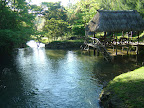
The inside of the cave struck me as completely alien. The stone, smoothed by the water which filled the entire cavern in the rainy season, was greyish-pink and cold. The candles barely illuminated the ceiling, which at times vanished in darkness, and other times reached down to make very narrow crawlways . Enrique showed us where to step and where to swim. When one of our candles would dip into the water we'd relight it quickly. We clambered up rickety ladders and clung to suspended pieces of rope. Several times we stopped to comment on how ridiculously dangerous the whole thing was. Enrique kindly carried my camera in a waterproof tub and we paused to tale the pictures you see, but given how disparate the environment of the cave was from normal experience, you can see that it's hard to tell if the formations stand a few centimeters or a few meters tall. The flash, and our candles failed to penetrate the fullest extent of the darkness, leaving me wondering if it went on forever.


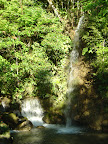
Eventually, we came to an underground waterfall, probably 4 meters in height with a knotted rope hanging in the middle of the cascade. With a boost at the bottom from Enrique, we all clambered up. I think I made it in three big steps and the scrambled over the rigging that supported the rope. A few more squeezes and stumbles later we came to a large opening and the darkness beyond refused to yield any clues to our candles. Enrique said you could keep going for another four more hours or so, but that we hadn’t paid for the full tour and would need to turn back now. We'd been at it for over an hour and we thought about the rest of the group waiting outside. We turned back.
We used a ladder to get down the waterfall and thought we would have to retrace all of our steps when Enrique made a few different turns and we found ourselves crouched in a tiny tunnel. By now our candles had burned to barely a quarter of their original size. Enrique showed us a small opening in the floor of the cave into which a brisk rivulet rushed. He propped himself over the dark hole at the end of the tiny tunnel and indicated where we should put our hands and feet. After we acknowledged that we understood, he turned sideways and disappeared into the hole. We heard no splash, nor anything else over the noise made by the falling water. The four of us looked at each other and exchanged some multilingual profanity. I went down after one of the Germans and George. Eventually, Enrique's headlamp emerged and I saw we dropped all of a meter or so. He helped me get my arms and legs situated until I looked like a giant, pale daddy-long-legs and I slowly lowered myself down, until I caught the falling water full in my face, which sped my descent considerably.
This shortcut had taken us nearly back to the entrance of the cave. On the way out I heard tiny noises in the dark and realized that bats covered the ceiling. I kept my own counsel, not wanting to freak anyone out. Right at the entrance Enrique pointed a tiny furry critter out to us. "Murcialago."
"Like the car!" I told George, who looked at me like I said "Purple broccoli Sunday!"
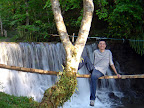
We blinked our way back into the light and Enrique said we could float in innertubes down the river to rejoin our group. George and I grabbed tubes and happily plopped ourselves in the river. The Germans watched very skeptically from the bank and decided to walk back.

We met up with our group after a very relaxing 15 minute tube ride and rode back to Cobán, our Spanish insufficient to describe the caves.
That evening we met up with Deborah, and her mom, aunt, and 12-year-old sister at the one discothèque in Cobán. We met Deborah's 30-something boyfriend who danced with her while her mom got jiggy wid it a few watchful feet away.
The next morning we lathered up with sunscreen and, along with several other tourists and a family of locals, headed off for Semuc Champey.
Even though Guatemala has about 15% the area of Texas, it takes quite a long time to get anywhere. So about 2 hours later we arrived at the remote park of Semuc Champey. George and I first hiked up to the Mirador before jumping in the famous pools. Practical as he is, George changed out of his jeans and into his swimsuit before making the kilometer-long hike that the trail sign marked as "Dificil."
As no changing rooms presented themselves, he did this in the middle of the trail, interrupted half way through by some inquisitive Germans.
I opted to stay in my pants and we began up the 580 steps to the lookout. We had a separate bag that had a change of clothes, our sandals, two liters of water, and around step 400 I swore there must also be some assorted lead weights in there.
The Mirador (after a concerning stop that offered no view whatsoever), as you can see, offered quite the view, but wasn't nearly as tasty as the one in San Antonio.
El Mirador
At Semuc Champe
with jungle all around. We stayed there for an hour or so and had our box lunches (the Spanish word for which is: box lunch, apparently).
We gathered our party and ventured forth in the sturdy HiAce and shortly arrived at the Gratis de Kan Ba, a makeshift hut on the side of the gorge. After some discussion only George, myself, and two young Germans who spoke better English than either of us opted to enter the cave. Enrique, our guide, practically ran up the side of the gorge to the entrance.
Kan'Ba
We got about ten feet into the cave when the guide switched on his headlamp and handed out candles -- candles! A minute later I was side-stroking my way through dark, deep, cold water with my candle in front of me.
The inside of the cave struck me as completely alien. The stone, smoothed by the water which filled the entire cavern in the rainy season, was greyish-pink and cold. The candles barely illuminated the ceiling, which at times vanished in darkness, and other times reached down to make very narrow crawlways . Enrique showed us where to step and where to swim. When one of our candles would dip into the water we'd relight it quickly. We clambered up rickety ladders and clung to suspended pieces of rope. Several times we stopped to comment on how ridiculously dangerous the whole thing was. Enrique kindly carried my camera in a waterproof tub and we paused to tale the pictures you see, but given how disparate the environment of the cave was from normal experience, you can see that it's hard to tell if the formations stand a few centimeters or a few meters tall. The flash, and our candles failed to penetrate the fullest extent of the darkness, leaving me wondering if it went on forever.
Some atmosphere
Eventually, we came to an underground waterfall, probably 4 meters in height with a knotted rope hanging in the middle of the cascade. With a boost at the bottom from Enrique, we all clambered up. I think I made it in three big steps and the scrambled over the rigging that supported the rope. A few more squeezes and stumbles later we came to a large opening and the darkness beyond refused to yield any clues to our candles. Enrique said you could keep going for another four more hours or so, but that we hadn’t paid for the full tour and would need to turn back now. We'd been at it for over an hour and we thought about the rest of the group waiting outside. We turned back.
We used a ladder to get down the waterfall and thought we would have to retrace all of our steps when Enrique made a few different turns and we found ourselves crouched in a tiny tunnel. By now our candles had burned to barely a quarter of their original size. Enrique showed us a small opening in the floor of the cave into which a brisk rivulet rushed. He propped himself over the dark hole at the end of the tiny tunnel and indicated where we should put our hands and feet. After we acknowledged that we understood, he turned sideways and disappeared into the hole. We heard no splash, nor anything else over the noise made by the falling water. The four of us looked at each other and exchanged some multilingual profanity. I went down after one of the Germans and George. Eventually, Enrique's headlamp emerged and I saw we dropped all of a meter or so. He helped me get my arms and legs situated until I looked like a giant, pale daddy-long-legs and I slowly lowered myself down, until I caught the falling water full in my face, which sped my descent considerably.
This shortcut had taken us nearly back to the entrance of the cave. On the way out I heard tiny noises in the dark and realized that bats covered the ceiling. I kept my own counsel, not wanting to freak anyone out. Right at the entrance Enrique pointed a tiny furry critter out to us. "Murcialago."
"Like the car!" I told George, who looked at me like I said "Purple broccoli Sunday!"
We blinked our way back into the light and Enrique said we could float in innertubes down the river to rejoin our group. George and I grabbed tubes and happily plopped ourselves in the river. The Germans watched very skeptically from the bank and decided to walk back.
Tubing home
That evening we met up with Deborah, and her mom, aunt, and 12-year-old sister at the one discothèque in Cobán. We met Deborah's 30-something boyfriend who danced with her while her mom got jiggy wid it a few watchful feet away.
Spelunking, part the first:
In 1998 a landowner outside of Cobán found a cave system on his property and quickly began marketing it. We understood that these "Caves of Rey Marco" stood just a bit outside of Cobán and, since the protest / demonstration / street theater has dissolved, we didn't have anywhere to go, so we booked a tour. The helpful driver from the hostel got us quickly out of town in an aging Toyota pickup. And then we kept going, and going. A painful squeal and jolt accompanied every bump and divot in the increasingly unimproved roads. Eventually we got to the entrance to the property. The whole thing sat nestled next to a hill. A small river that cascaded out of the hill carved the caves in rather short order, in the lifespan of rocks. An earnest man, who later turned out to be the son of the owner, briefed us on what to expect inside. He detailed the minute of silence and darkness we would observe at the end of the cave. He also related the strong energy found in the cave, and invited us to rub our hands together without quite touching them and then feel the energy between them. The he handed us our hard hats with head lamps and told us we should get our galoshes next door.
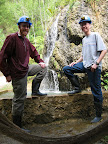 The owner had planted tiny orange orchids lining the path on the way up.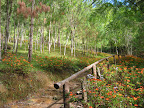
Both George and I had visited Natural Bridge Caverns in Texas and thought this would be somewhat similar.
Thirty minutes later, in the musty darkness, hanging by one hand from a rope line over rushing water, we realized we were slightly incorrect in our expectations. We needed the headlamps, we needed the galoshes, and, both being nearly a foot taller than an average Guatemalan, appreciated the hard hats immediately. Thankfully, we went in with a family with two school age children and found solace knowing that they probably wouldn't place the kids of paying customers in mortal peril. After twenty minutes or so of clambering, head-bumping and the occasional terrified wail, we came to the main chamber where we met "The Leaning Tower" and "The World Cup." At the guide's instruction we clicked off our headlamps. It's eerie to think that everything in these caves normally exists in this state of complete darkness in which we found (or possibly lost) ourselves.
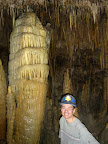
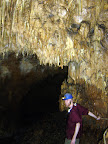
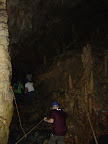
Going out seemed easier, but I kept thinking about the enormous liability the owner carried and we agreed nothing like this would ever fly in the US. The use of the cavern differed from those I had visited in the US as well. At Natural Bridge Caverns, the designers took measures to ensure the safety of guests (walkways, fixed lighting, ventilation, and the like), but also of the cavern itself, with frequent exhortations not to touch and of the rock, as the oils in our skin would stop the growth of the formations. Here we had no choice but to touch the rock. Mysterious source of energy or no, I felt like the whole project geared towards providing adventure and generating profit, and less on education or conservation. I found this focus somewhat surprising, given the booming eco-tourism industry in Guatemala, I thought preservation would have higher priority. On the other hand, rocks are rocks, and regardless of what we do, they'll be here long after we're gone.
This concept of "us" being "gone" changed from a somewhat trite conceit to an imminent possibility the next day when we met Kan Ba.
Absolutely no clue
This way up
Both George and I had visited Natural Bridge Caverns in Texas and thought this would be somewhat similar.
Thirty minutes later, in the musty darkness, hanging by one hand from a rope line over rushing water, we realized we were slightly incorrect in our expectations. We needed the headlamps, we needed the galoshes, and, both being nearly a foot taller than an average Guatemalan, appreciated the hard hats immediately. Thankfully, we went in with a family with two school age children and found solace knowing that they probably wouldn't place the kids of paying customers in mortal peril. After twenty minutes or so of clambering, head-bumping and the occasional terrified wail, we came to the main chamber where we met "The Leaning Tower" and "The World Cup." At the guide's instruction we clicked off our headlamps. It's eerie to think that everything in these caves normally exists in this state of complete darkness in which we found (or possibly lost) ourselves.
The leaning tower
Homeward bound
Going out seemed easier, but I kept thinking about the enormous liability the owner carried and we agreed nothing like this would ever fly in the US. The use of the cavern differed from those I had visited in the US as well. At Natural Bridge Caverns, the designers took measures to ensure the safety of guests (walkways, fixed lighting, ventilation, and the like), but also of the cavern itself, with frequent exhortations not to touch and of the rock, as the oils in our skin would stop the growth of the formations. Here we had no choice but to touch the rock. Mysterious source of energy or no, I felt like the whole project geared towards providing adventure and generating profit, and less on education or conservation. I found this focus somewhat surprising, given the booming eco-tourism industry in Guatemala, I thought preservation would have higher priority. On the other hand, rocks are rocks, and regardless of what we do, they'll be here long after we're gone.
This concept of "us" being "gone" changed from a somewhat trite conceit to an imminent possibility the next day when we met Kan Ba.
Outside Rey Marcos
Thursday, 29 March 2007
La Semana Santa
The week before Easter is a holiday for almost everyone. The hospitalito closed and we had no choice but to head out for some traveling. We knew this in advance and George had planned for many of the places to see and things to do. He had previously visited Guatemala before and kindly planned all our travel. Since we left Friday morning, we had 10 days worth of clothes etc. to pack. I managed to just barely cram what I needed into my backpack (to be clear, this isn't a hiking backpack, it's my high-school book bag). George, having more foresight, borrowed a US Army combat field rucksack with space for a toddler-age set of triplets plus approximately a zillion smaller pouches. We took along a third bag for things we might find along the way.
We traveled by mini bus to Tuculutan (the nearest spot with stores) and then via a special Litegua bus to Rio Hondo. Haggling there nearly cut our fare to Cobán in half and we mini bussed it to Cobán where we got ourselves to the nunnery with minimal difficulty. Seriously, our hostel was an old nunnery that cost about $12 per person per night (considerably lower than the initial price of living there, and they didn't even have cable TV)
We traveled by mini bus to Tuculutan (the nearest spot with stores) and then via a special Litegua bus to Rio Hondo. Haggling there nearly cut our fare to Cobán in half and we mini bussed it to Cobán where we got ourselves to the nunnery with minimal difficulty. Seriously, our hostel was an old nunnery that cost about $12 per person per night (considerably lower than the initial price of living there, and they didn't even have cable TV)
Subscribe to:
Posts (Atom)